

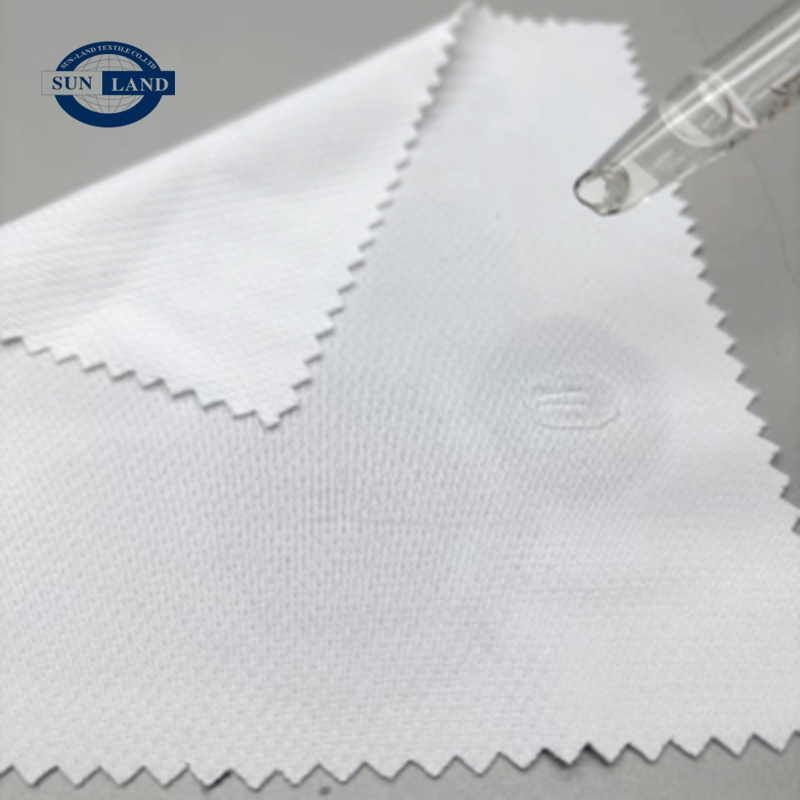
The unidirectional moisture-wicking function of the fabric is developed on the basis of moisture-wicking and quick-drying, which means that moisture and heat are quickly transferred from the inner layer of the fabric (skin contact layer) to the outer layer of the fabric (air contact layer) and evaporate quickly, and the moisture , The heat does not stay in the inner layer. This type of fabric does not stick to the skin and is very comfortable to wear. It is the first choice for sports fabrics.
Two conditions are required for unidirectional humidification:
1. The inner layer of the fabric has a good capillary effect;
2. The outer layer of the fabric has a good diffusion effect on moisture.
What is the difference between moisture-wicking and quick-drying fabrics and unidirectional moisture-wicking fabrics?
1. Moisture-conducting and quick-drying fabric: By increasing the evaporation area, the sweat can quickly spread on the fabric to achieve the purpose of quick-drying.
2. One-way moisture guide is faster than fabric: through the different hydrophilicity and hydrophobicity of the inner and outer fabrics, that is, the outer layer of the fabric is hydrophilic and the inner layer is mostly hydrophobic, sweat is transmitted from a small part of the inner layer to the hydrophilic part of the fabric outer layer, and evaporates quickly on the outer layer.
Since various materials have different hygroscopicity and moisture conductivity, choose materials with better moisture conductivity for the inside, and materials with poor moisture conductivity for the outside, then sweat will easily transfer from the inside to the outside and evaporate quickly. The moisture absorption of the inner material should not be too good, otherwise the sweat will not be fully discharged.
The same raw material can also change its hygroscopicity and moisture permeability through spinning or other finishing processes, for example: strong twisted yarn can significantly improve its moisture permeability. In addition, the yarn can be given a hydrophilic or water-repellent finish before weaving, which changes its properties. The thinner the fiber or the more complex the cross-sectional shape of the fiber, the more grooves and micropores on the surface, that is, the greater the degree of irregularity of the fiber, the greater the number of capillaries formed, and the stronger the moisture conductivity of the fabric.
Using the principle of capillary differential effect of special-shaped chemical fiber raw materials, sweat is transferred from the inner side with weak moisture-conducting ability to the outer side with relatively strong moisture-conducting ability, and evaporates and dries quickly on the outer side.
Polypropylene yarn and polyester are used to interweave, so that moisture or sweat enters the polyester surface from the polypropylene surface, but does not enter the polypropylene surface from the polyester surface, and can achieve the effect of one-way moisture transfer. This design has the following advantages:
(1) The water-repellent effect of polypropylene can quickly transfer sweat to the body to keep the body surface dry and comfortable.
(2) Combined with the quick-drying characteristics of polyester, the sweat from the skin can be evaporated as soon as possible, and the clothing can be kept beautiful.
The special three-dimensional mesh structure can promote and accelerate the transfer of moisture and heat from the inner layer to the outer layer. The larger the mesh on the inner layer, the smaller the mesh on the outer layer, so that the sweat is accelerated from the inside to the outside, and evaporates and dries quickly on the outer layer.
After finishing, the thermal resistance and moisture resistance of one side of the fabric are reduced, and the heat and moisture transfer of this side is enhanced, which is conducive to perspiration and moisture conduction. For example: one-sided finishing on the fabric by printing, so that the oil-repellent and water-repellent finishing agent is evenly distributed on one side of the fabric, and the penetration depth of the finishing agent on the fabric is controlled to make one side of the fabric hydrophilic. The side is hydrophobic, forming a hydrophilic and hydrophobic double-sided structure. Since the moisture conductivity of the hydrophobic surface is stronger than that of the hydrophilic side, sweat is directed from the hydrophobic side to the hydrophilic side, and can quickly diffuse and evaporate, keeping the inner layer of the fabric relatively dry.
Advantages of single-sided moisture-wicking fabrics
1. Comfort: Moisture-wicking fabric keeps the wearer dry and comfortable during physical activity. The fabric absorbs sweat and moisture, preventing the wearer from feeling wet or sticky.
2. Improve performance: Moisture-wicking fabrics can improve performance by regulating body temperature, reducing friction between the skin and clothing, and providing ventilation for the body.
3. Durability: The moisture-wicking fabric is durable and long-lasting for a variety of applications.
4. Easy Care: The moisture-wicking fabric is easy to care for and can be machine washed and dried without losing its properties.
Disadvantages of single-sided moisture-wicking fabrics
1. Cost: Due to the special manufacturing process, moisture-wicking fabrics are more expensive than traditional fabrics.
2. Odor retention: Some moisture-wicking fabrics, especially those made from synthetic materials, may retain odor.
3. Environmental impact: Some synthetic fibers used in moisture-wicking fabrics are not environmentally friendly and may have an impact on the environment.